

The Food Domain Sectors: A Complete Map of What You Are Actually Eating
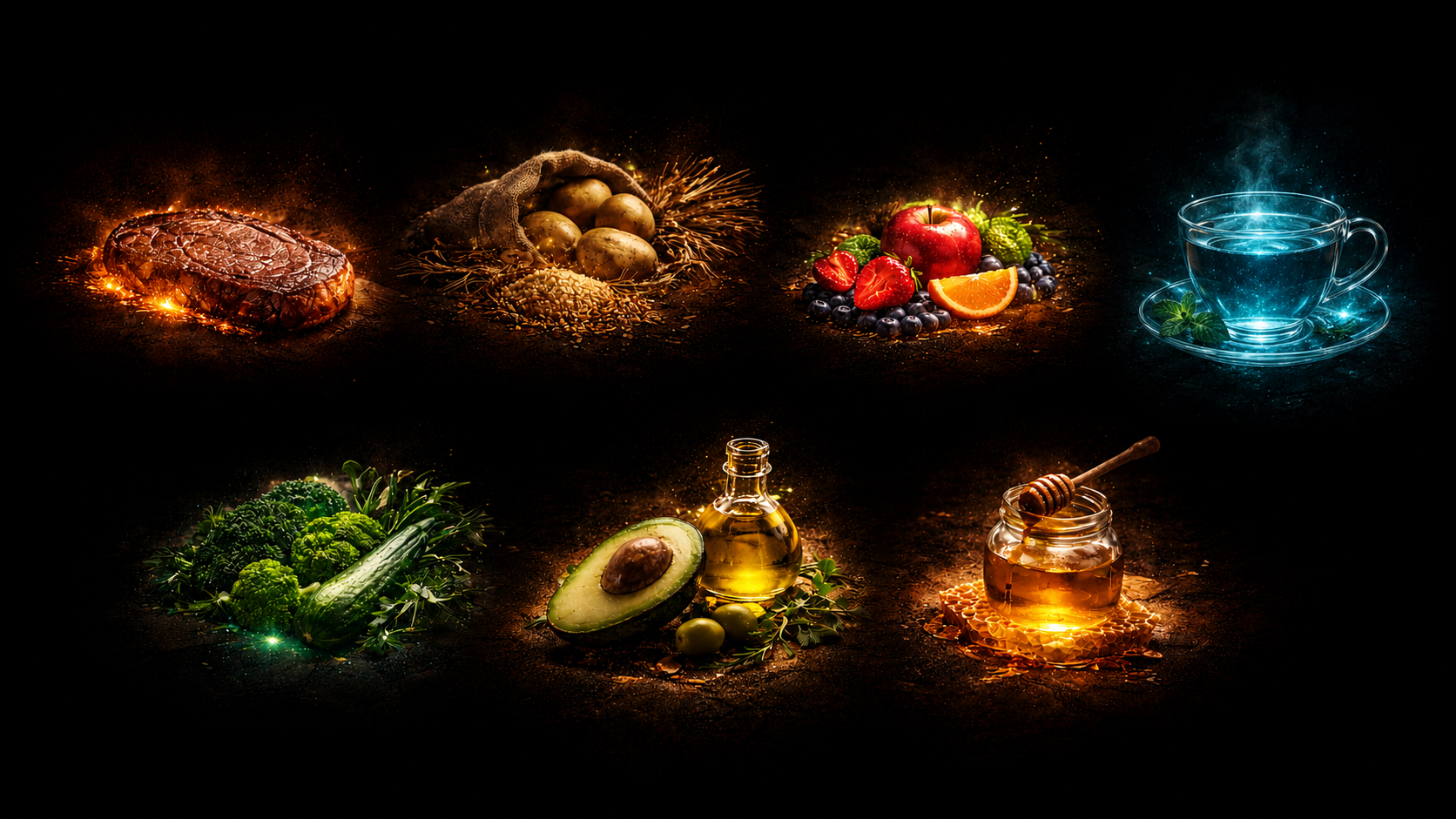
The Food Domain Sectors: A Complete Map of What You Are Actually Eating
Domain Sectors OverviewFood is not a single input. It is seven distinct categories of input — each one acting on the system differently, each one carrying its own signal, each one producing its own quality of state.
The food domain is the most active input domain in most men's lives. It operates multiple times a day, across all three layers simultaneously, in direct relationship to every other variable in the system. And yet most men navigate it through a single lens — calories, macros, or clean versus processed — that collapses seven fundamentally different categories of input into one undifferentiated question: did I eat the right things?
The answer to that question depends entirely on which category of food is being considered. Because Meat does not act on the system the way Fruit does. Fats do not operate the way Carbohydrates do. Each sector of the food domain has its own relationship to the three layers, its own signal character, its own energetic quality, and its own position within the system's larger logic. A man who reads all food through the same lens is not reading food at all. He is reading a simplified version of food that tells him almost nothing about what is actually happening when he eats.
The seven food domain sectors are the framework's answer to that incompleteness. They are not nutritional categories in the conventional sense. They are functional categories — organized by how each type of food acts on the masculine system, what it builds, what signal it carries, and what quality of state it tends to produce. Understanding them changes what selection means and what eating with intelligence actually looks like.
The Seven Food Domain Sectors
Why Sectors, Not Just Foods
The sector framework exists because individual food choices cannot be made intelligently without understanding the category they belong to. A man who knows that bison is a high-quality protein but does not understand the Meat sector — its structural density, its signal character, its relationship to the system's building and activation functions — cannot know when bison is the right input and when something from a different sector is more appropriate for what the system actually needs in that moment.
The sectors are not rigid boxes. Foods within a sector vary significantly — sometimes dramatically — in their specific signal character and energetic quality. That variation is what the individual food articles within each sector explore. But the sector provides the orienting framework: the shared logic that connects individual foods within a category and distinguishes that category from the six others.
This is the same logic that distinguishes the six input domains from one another. Food and supplements are both inputs, but they operate on fundamentally different principles and require fundamentally different reading. Within the food domain, Meat and Fruit are both foods, but they act on the system through fundamentally different mechanisms and produce fundamentally different outputs. The sector framework makes those differences visible — and makes selection intelligent rather than arbitrary.
How to Read the Sector Articles
Each sector has its own dedicated article that goes deeper into what that category is, how it operates across the three layers, its signature energetic quality, and the range of variation within it. The individual food articles within each sector go deeper still — into the specific signal character, elemental profile, archetypal energy, and practical application of each food as a precision input within the framework.
The sector articles are designed to be read before the individual food articles — not because they are prerequisites, but because they provide the orienting context that makes the individual articles more useful. A man who understands the Meat sector reads the bison article differently than a man who encounters bison in isolation. He knows where it sits within the category, how its signal relates to other meats, and what about it is universal to the sector versus what is specific to the animal.
The sectors can be read in any order. But the logic of the food domain builds from the domain pillar article through the sectors overview through each sector's dedicated article and into the individual food posts. A man who follows that sequence develops a progressively finer resolution picture of the most active input domain in his life — and the capacity to select from it with the precision the system deserves.
You have been eating your entire life. But eating and selecting are different things. Selection requires a map — a framework that tells you what each category of food is doing, why it matters, and when it is the right input for the system you are actually in right now. That is what the food domain sectors provide. Not a diet. A reading. And a man who can read his food this way has access to a quality of precision that no macro calculator was ever designed to deliver.